
Link Building in 2026: What Still Works and What Doesn’t

Every year, someone declares link building dead.
Every year, sites competing in difficult search results continue acquiring links.
The more useful question is no longer whether links matter. It is which links are still worth acquiring, what makes them valuable, and how the answer has changed as Google’s spam systems and AI-driven search have evolved.
Two shifts matter in 2026.
Google has continued tightening its enforcement around manipulative content and linking patterns. At the same time, AI search has made off-site brand visibility increasingly important alongside traditional authority signals.
That changes the job.
Link building is no longer about accumulating the largest backlink count or finding the highest Domain Rating available for the budget. The strongest strategies combine relevance, editorial fit, brand visibility and operational discipline.
If you are new to the subject, start with our Link Building Fundamentals guide. This guide focuses on what has changed and what still deserves budget in 2026.
What Google’s 2026 update record actually shows
Google has confirmed seven ranking-related updates so far in 2026: two core updates, four spam updates and one Discover update.
| Update | Started | Duration |
| February 2026 Discover update | 5 February | 21 days, 17 hours |
| March 2026 spam update | 24 March | 19 hours, 30 minutes |
| March 2026 core update | 27 March | 12 days, 4 hours |
| May 2026 core update | 21 May | 11 days, 21 hours |
| June 2026 spam update | 24 June | 2 days, 1 hour |
| August 2026 spam update | 18 August | 2 days, 16 hours |
| September 2026 spam update | 24 September | 13 days, 16 hours |
One detail matters for link builders: Google has not labelled any of those updates a link spam update.
That does not mean unnatural links have stopped being detected.
Google introduced its SpamBrain-based link spam system years ago and has explicitly said that it can identify both sites acquiring links and sites being used to pass unnatural outbound links. Its stated objective is to neutralise those links so that the ranking credit they were expected to provide disappears.
That distinction is important.
A weak link does not need to trigger a dramatic penalty or a manual-action notification to fail. It can remain live, remain indexed and remain visible in your backlink tools while contributing little or nothing to rankings.
In practical terms, avoiding penalties is too low a standard.
The real objective is acquiring placements worth having even after Google has evaluated the site, page, context and linking pattern.
What still works in link building
Topical relevance before headline authority
Domain metrics remain useful filters, but they should not make the decision for you.
A smaller publication with genuine coverage of your subject, relevant organic visibility and an audience that makes sense for your target page can be a better opportunity than a much larger domain where the placement has no editorial connection to the rest of the site.
That does not mean every broad publication is weak.
A national newspaper can legitimately cover business, technology, sport, politics and travel. The problem is not the number of categories. It is whether your article belongs there.
Look at what the site actually ranks for, what it publishes repeatedly and whether your placement fits the same audience.
Context matters
A link should make sense to somebody reading the article without knowing anything about SEO.
That sounds obvious, but it rules out a surprising number of placements.
A relevant reference inside a useful article gives both readers and search engines clearer information about the relationship between the two pages. A commercial link forced into unrelated copy does the opposite.
The same principle applies whether you are building a new guest post or adding a link to an existing page.
Our Guest Posting vs. Niche Edits guide covers the operational differences between those formats in more detail.
Natural anchor text
Aggressive exact-match anchor strategies create patterns that are difficult to justify editorially.
Google’s spam policies specifically identify optimised anchor text in distributed articles and press releases as an example of problematic linking when the purpose is manipulating rankings.
That does not make every keyword-containing anchor dangerous.
It means the anchor should fit the sentence first.
Branded anchors, URLs, partial-match descriptions and natural phrases create a much more defensible profile than repeatedly forcing the same commercial keyword into unrelated publications.
There is another reason branded anchors deserve attention in 2026: AI visibility data increasingly points towards brand signals across the wider web.
More on that shortly.
Digital PR and genuinely earned citations
Links chosen independently by journalists, researchers, editors and industry writers remain among the hardest placements to manufacture — which is precisely why they are valuable.
Original research, expert commentary, proprietary data and timely reactions to breaking stories can all create reasons for publishers to cite a brand without being asked to insert a particular commercial anchor.
The outcome is not always predictable.
That makes digital PR less convenient than ordering a placement, but it also creates opportunities on domains that conventional outreach or marketplaces may never reach.
A blended acquisition model
There is no reason every link needs to come from the same channel.
Marketplaces solve a discovery and workflow problem. They let teams see available publishers, compare opportunities and reduce the hours spent prospecting, negotiating and following up.
Targeted outreach can reach publishers that are not available through an existing inventory.
Digital PR can create earned coverage that neither method can guarantee.
The strongest operation is therefore often a blended one: use the acquisition method that fits the target rather than forcing every campaign through the same process.
We looked at the operational cost of those choices in our guide to Marketplace Links vs. Cold Outreach.
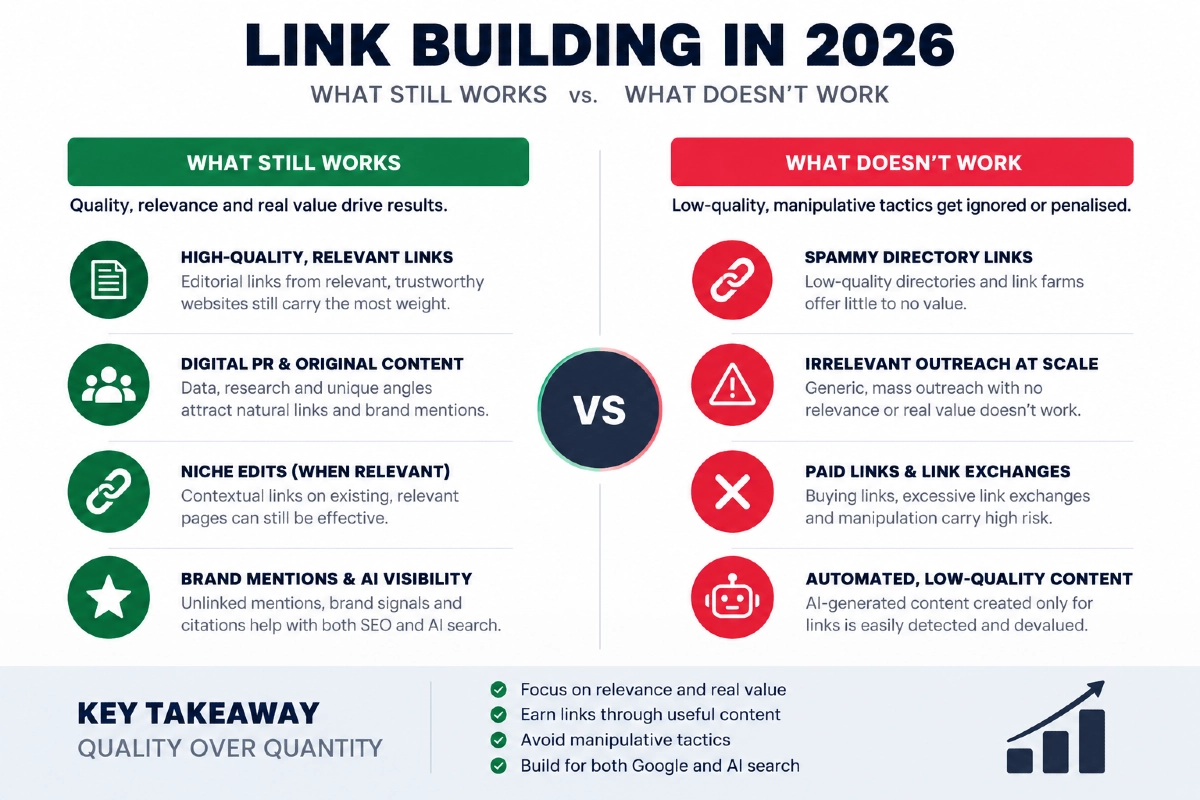
What is losing value
Publishing anywhere that will accept the link
Broad sites are not automatically bad sites.
That distinction matters.
The warning sign is a publication where unrelated commercial articles appear to exist primarily because somebody paid to place them.
If a site’s recent posts jump from payday loans to casino bonuses, supplements, crypto exchanges and plumbing services with no coherent audience or editorial purpose, the headline authority metric tells you very little about the value of the opportunity.
This is partly practitioner judgement rather than a rule Google has published.
But it aligns with the wider direction of Google’s spam policies: context, oversight and purpose increasingly matter.
Exact-match anchors at scale
One anchor does not define a backlink profile.
Patterns do.
If the same money page repeatedly receives the same commercial anchor from unrelated publications, it becomes increasingly difficult to describe that profile as the result of independent editorial choices.
That is why anchor strategy should be managed at campaign level rather than link by link.
The question is not simply whether a particular anchor looks acceptable.
It is what the entire profile looks like after another 20, 50 or 100 placements.
Scaled content used mainly as a link vehicle
Google’s scaled content abuse policy is deliberately technology-neutral.
The issue is not whether a page was written by AI.
The issue is whether large amounts of content are being produced primarily to manipulate search rankings rather than provide value to users.
Google explicitly says that the policy can apply whether the content was created with automation, by humans or through a combination of both.
That matters for link building because low-effort guest articles are easy to scale.
Producing 500 technically unique articles does not make the strategy strong if each page exists primarily as a container for a commercial link.
Site reputation abuse
Site reputation abuse is another policy that link builders need to understand properly.
It concerns third-party content published primarily to take advantage of the ranking signals of an established host rather than because the content genuinely belongs on that publication.
Again, a multi-topic website is not automatically guilty of this.
The more useful questions are whether the host exercises real editorial oversight, whether the subject belongs within the publication and whether the section appears to serve readers rather than simply monetise the site’s existing authority.
Backlink count as the main KPI
Raw backlink totals are increasingly poor measures of progress.
Ten links from the same weak network are not equivalent to ten independently relevant referring domains.
A thousand links from sitewide templates can inflate a report without meaningfully improving authority.
Measure the quality and diversity of referring domains, the relevance of placements, the pages receiving links and what happens to visibility over time.
And in 2026, there is another metric worth adding: brand mentions.
What AI search changes
AI search has added a new dimension to off-site SEO.
One of the most useful datasets so far comes from Ahrefs, which analysed 75,000 established brands and compared a range of signals with visibility in Google’s AI Overviews.
The strongest correlation was not backlink count.
Branded web mentions showed a correlation of 0.664 with AI Overview visibility. Branded anchor text followed at 0.527, with branded search volume at 0.392.
Traditional link metrics appeared further down the study: Domain Rating at 0.326, referring domains at 0.295 and total backlink count at 0.218.
A later Ahrefs study expanded the analysis across ChatGPT, Google AI Mode and AI Overviews. YouTube mentions showed the strongest overall correlation at approximately 0.737, while branded web mentions remained strongly associated with visibility across the different platforms.
Those figures need context.
This is correlation, not causation.
The studies do not prove that creating ten new brand mentions will make an AI system recommend your company.
The sample was also deliberately weighted towards established brands. Ahrefs filtered for domains with a DR above 40 and a sufficiently large branded keyword before selecting the 75,000 companies.
And none of the research shows that links have stopped mattering.
They remain positively correlated with AI visibility.
The more interesting conclusion is that links are now only part of the off-site picture.
A strong editorial placement can create a backlink, a branded anchor, an unlinked brand reference, referral exposure and wider association between your company and a particular topic.
A weak placement nobody reads may technically create a backlink while doing almost nothing for the other signals.
That changes how link quality should be judged.
Link building in regulated industries
For teams working in gambling, finance, health and other regulated or commercially sensitive sectors, publisher selection creates an additional layer of difficulty.
Good publications often have stricter rules for these subjects.
They may prohibit gambling terminology in titles, restrict commercial anchors, require authoritative supporting sources, insist that an article fits an existing editorial category or reject content that reads primarily as promotion.
From an operational perspective, those restrictions create friction.
From a quality perspective, they can be a positive signal.
A publisher that rejects unsuitable articles, rewrites titles and enforces its own editorial rules is demonstrating genuine oversight.
A publisher that accepts almost any subject, anchor or claim without question deserves much closer scrutiny.
For regulated verticals in particular, the commercial link should fit naturally inside an article that would still be useful if the link were removed.
A practical framework for evaluating links in 2026
Before approving a placement, ask five questions:
- Is it relevant? Does the publication genuinely cover the subject, and does the target page make sense for its audience?
- Does the site have a real search presence? Look beyond a single DR score and examine organic visibility, ranking topics and traffic trends.
- Is there real editorial control? Does the publication have standards, guidelines and evidence that unsuitable content gets rejected?
- Does the linking pattern look credible? Review recent commercial content, outbound links and whether every article appears to exist for placement purposes.
- Does the anchor make sense in the wider profile? Judge it against links already pointing to the target, not in isolation.
After acquisition, measure more than the number of live URLs.
Track referring domains, target-page visibility, anchor distribution and whether placements remain indexed and live. Where possible, monitor brand mentions and AI visibility for the topics that matter commercially.
No single metric proves that a link caused a ranking movement.
SEO performance is affected by content changes, technical work, competitors, algorithm updates and links simultaneously.
The goal is to build a body of evidence over time.
Scale the process, not the shortcuts
The pressure to lower quality usually appears when volume increases.
At ten placements a month, almost everything can be reviewed manually.
At 100, poor processes become expensive.
That is why scalable link building depends on briefs, publisher research, editorial QA, anchor tracking and a clear record of which domains have already been used.
Automation can remove administration.
It should not remove judgement.
Our guide to scaling link building to 100+ links per month covers how agencies can structure that workflow without assuming every increase in volume requires another hire.
Where Serpify fits
Serpify is designed around the part of link acquisition that is easiest to systemise: discovering, filtering and managing publisher opportunities.
Every publisher in the inventory is manually vetted and reviewed regularly. Buyers can filter opportunities using factors including traffic, Domain Rating, niche, language and geography before committing budget.
That does not remove the need for editorial judgement.
It reduces the amount of time teams spend reaching the point where that judgement can be applied.
Content can also be requested alongside a placement, with Serpify currently advertising delivery in less than 24 business hours when content is requested. Publisher publication times remain separate and vary according to the site’s own process.
Orders and live URLs can then be tracked through the platform rather than across dozens of separate email conversations.
The objective is not to maximise the number of links.
It is to make it easier to find and manage the links that survive a serious quality review.
Explore Serpify’s link-building marketplace and filter opportunities by the criteria that matter for your campaign.
Frequently asked questions
Is link building still worth it in 2026?
Yes, but the value is concentrated in better links. Google continues to use links as part of its search systems while actively neutralising manipulative linking patterns. Relevance, editorial context and source quality matter far more than simply increasing the backlink total.
Did Google release a link spam update in 2026?
Not as of 21 October 2026. Google has confirmed four spam updates this year, but none was specifically labelled a link spam update. Its SpamBrain systems can already identify and neutralise unnatural links independently of a named link-spam rollout.
Do backlinks matter for AI search?
They remain positively correlated with AI visibility, but recent Ahrefs research found stronger relationships with branded web mentions and branded anchors. The practical opportunity is to seek placements that create both useful links and genuine brand visibility.
Are exact-match anchors bad?
Not automatically. The risk comes from patterns. Repeated keyword-heavy anchors created primarily to influence rankings can become difficult to justify editorially and fall within the kinds of linking practices Google’s spam policies warn against.
Does a high Domain Rating make a link good?
No. DR is a useful third-party comparison metric, not a Google ranking score. A high-DR site can still be irrelevant, poorly maintained or overloaded with commercial placements. Use authority metrics to narrow the shortlist, then evaluate the publication itself.
The takeaway
Link building in 2026 is not dead.
Low-effort link building is simply getting harder to justify.
The strongest placements now sit at the intersection of relevance, editorial quality, authority and brand visibility. They make sense to the reader, fit the publication and contribute to something larger than a backlink count.
AI search strengthens that argument rather than replacing traditional link building. The evidence so far suggests that brands benefit from being discussed across the web, while links remain one part of that wider footprint.
The strategy is therefore not to build as many links as possible.
Build fewer links you would still want if Domain Rating disappeared tomorrow.