
Marketplace Links vs. Cold Outreach Links: The Real Cost of Acquiring a Link

Ask ten agency owners whether cold outreach or a link marketplace is more cost-effective and you will probably get ten different answers.
Most of them will start by comparing placement prices.
That is not the comparison that matters.
The more useful question is: what does it actually cost to get one suitable link live?
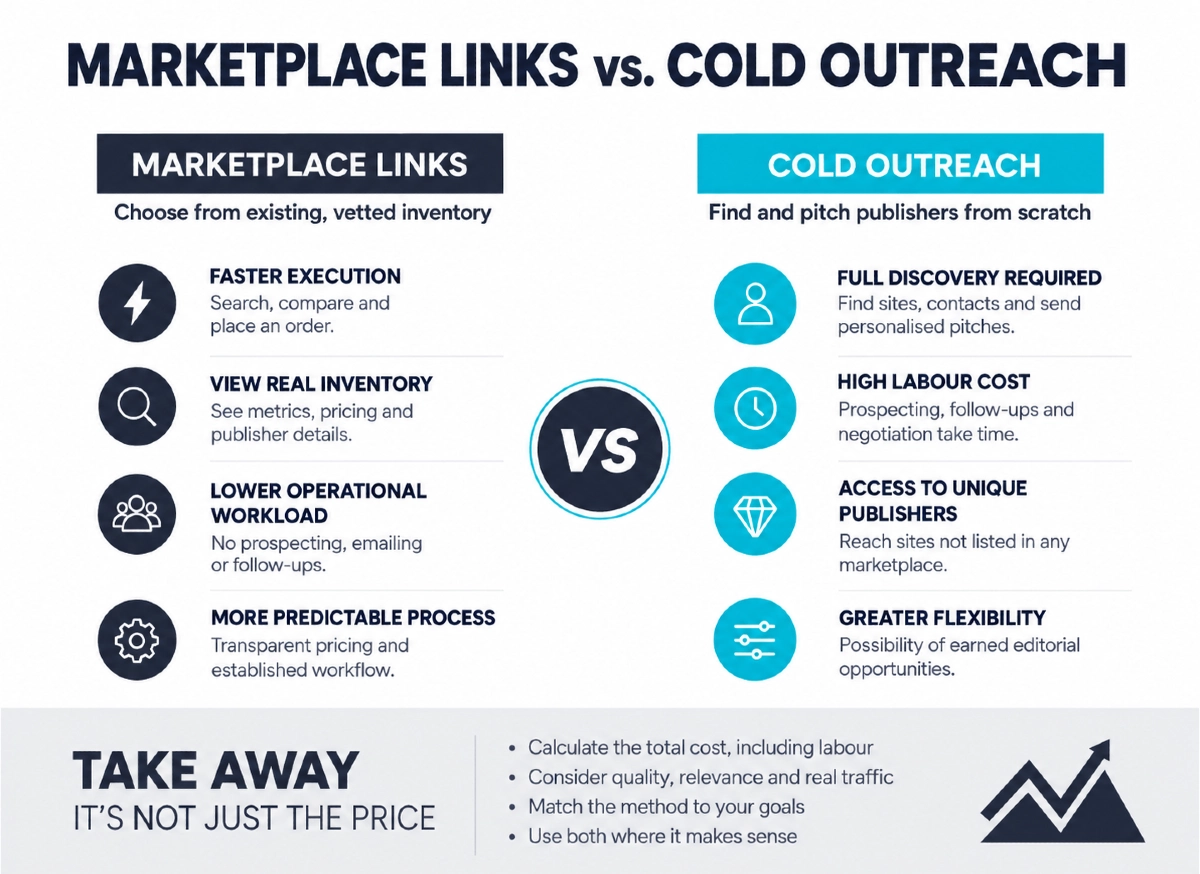
Cold outreach can create access to publishers that are unavailable through any marketplace. It can produce genuinely earned editorial opportunities and relationships that become more valuable over time.
A marketplace solves a different problem. It trades some of that open-ended discovery for visible inventory, predictable pricing and dramatically less operational work.
Once labour enters the calculation, the economics start to look very different.
The structural difference
Cold outreach begins with an empty prospect list.
Someone has to find relevant sites, qualify them, locate the right contacts, write the initial emails, follow up, handle replies, negotiate terms and then manage the placement through publication.
A marketplace begins further along the process.
The publisher relationships already exist. Available inventory can be searched and compared before an order is placed, and much of the contact, negotiation and follow-up work has already happened upstream.
That does not make marketplace placements automatically cheaper.
In fact, BuzzStream’s updated 2026 guest-post research found the opposite at the placement level. Its dataset put the average estimated direct price at $295, compared with $461 through a vendor. High-quality placements were considerably more expensive again.
That is precisely why placement price alone is the wrong metric.
The question is what happens when the cost of acquiring that placement is added to the invoice.
The acquisition channel is only one part of the wider link-building decision. Our Link Building Fundamentals guide covers the broader framework around relevance, link quality, anchor text and acquisition strategy. Once a publisher is available, the format matters too: our Guest Posting vs. Niche Edits comparison looks specifically at the trade-off between creating a new article and placing a link within an existing page.
Cold outreach: the hidden labour cost
Consider a campaign targeting 100 publishers.
For this model, we will use a fully loaded labour cost of £35 per hour. This is a modelling assumption, not an industry benchmark. An agency should replace it with its own internal cost.
We also need a reply rate.
Backlinko and Pitchbox analysed 12 million outreach emails and found an overall response rate of 8.5%. The research dates from 2019, so it should not be treated as a guaranteed 2026 performance benchmark. It does, however, provide a large established dataset that can be used as the basis for a model.
Finally, this model assumes that 18% of replies become live placements.
That 18% figure is an illustrative modelling assumption. It is not an industry benchmark.
| Activity | Time per unit | Volume | Labour |
|---|---|---|---|
| Prospecting and qualifying sites | 0.15 hr | 100 | 15.0 hrs |
| Personalised first emails | 0.10 hr | 100 | 10.0 hrs |
| Two templated follow-ups | 0.03 hr | 200 | 6.0 hrs |
| Reply handling and negotiation | 0.50 hr | 8.5 replies | 4.25 hrs |
| Placement management and QA | 0.50 hr | ~1.5 placements | 0.75 hrs |
| Total | 36.0 hrs |
An 8.5% reply rate produces approximately 8.5 replies.
At the assumed 18% reply-to-placement conversion rate, those 100 prospects generate around 1.53 live placements.
That works out at approximately 23.5 labour hours per live link.
At £35 per hour, the labour component alone is approximately £824 per placement.
And that is before content production, outreach software or any publisher fee is included.
SERPreach reports from its own dataset of more than 100,000 outreach emails that roughly 80% of webmasters who responded requested payment. This is proprietary provider data rather than a universal industry benchmark, but it illustrates why publisher fees do not necessarily disappear when links are acquired through outreach.
If we model £80–£150 in content costs, £15–£30 in outreach infrastructure and a £200–£400 publisher fee across 80% of placements, the expected publisher-fee component becomes £160–£320.
| Cost | Illustrative cost per live link |
|---|---|
| Labour | ~£824 |
| Content | £80–£150 |
| Expected publisher fee | £160–£320 |
| Outreach infrastructure | £15–£30 |
| Illustrative fully loaded cost | ~£1,079–£1,324 |
Those figures are not intended as a universal market price.
Change the hourly rate, reply rate, conversion rate or publisher fee and the result changes with them.
That is the point of calculating it.
Marketplace acquisition: what actually disappears
Now apply the same logic to a marketplace workflow.
There is still work involved. Someone needs to filter inventory, evaluate the publisher, prepare content or a brief and check the final publication.
But prospecting, contact discovery, cold emailing and repeated follow-ups are largely removed from the buyer’s workflow.
| Activity | Estimated labour |
|---|---|
| Filter inventory and select publisher | 0.30 hrs |
| Prepare brief or supply content | 0.20 hrs |
| Publication QA and link check | 0.20 hrs |
| Expected revision handling | 0.075 hrs |
| Total | ~0.78 hrs |
At the same £35 hourly rate, that represents approximately £27 in internal labour per placement.
Compared with the cold-outreach model, labour time has fallen by around 97%.
That does not mean the marketplace link itself is 97% cheaper.
It means the agency has removed almost all of the acquisition labour surrounding it.
That distinction matters.
BuzzStream’s 2026 pricing research illustrates why. Its average vendor price of $461 was higher than the estimated $295 direct price, but vendors typically handle work such as establishing the publisher connection and managing publication.
The placement fee can therefore be higher while the total operational cost remains competitive.
Side by side
The distinction becomes clearer when the two workflows are compared directly.
| Metric | Cold outreach | Marketplace |
|---|---|---|
| Labour per placement | ~23.5 hrs | ~0.78 hrs |
| Labour cost at £35/hr | ~£824 | ~£27 |
| Prospecting required | Yes | No or limited |
| Publisher negotiation | Yes | Usually handled upstream |
| Inventory selection | Research required | Search/filter existing inventory |
| Follow-up required | Yes | Usually limited |
| Publication QA | Buyer-managed | Buyer/platform-managed depending on service |
| Unlisted publisher discovery | Strong | Limited to available inventory |
| Cost predictability | Lower | Higher |
| Turnaround | Campaign-dependent | Inventory and publisher-dependent |
The biggest marketplace saving in this model is therefore not necessarily the price of the placement.
It is everything that happens before the placement exists.
The price of the link is not the cost of the link
Imagine two comparable publishers.
One quotes £300 after your team finds the site, identifies an editor, sends several emails and negotiates the placement.
The other appears in a marketplace for £400.
Looking only at the publisher fee makes the first opportunity £100 cheaper.
But if acquiring that £300 placement required several hours of employee time, the cheaper invoice may have produced the more expensive link.
The reverse can also happen.
A marketplace may contain a publisher priced well above what an experienced outreach team could negotiate directly. Agencies with established relationships, efficient processes and strong conversion rates may therefore achieve much better outreach economics than the model above.
There is no universal winner.
The useful metric is fully loaded cost per suitable live link.
Where cold outreach still earns its keep
Labour efficiency is not the only thing that matters.
Cold outreach has one major structural advantage over any fixed marketplace: the potential universe of publishers is much larger.
If you specifically want coverage from a particular industry publication, regional newspaper, specialist resource or company blog, you can approach it whether or not that site has ever listed a placement for sale.
That matters even more when the objective is an earned link rather than a purchased placement.
Original research, newsworthy data, expert commentary and digital PR can produce editorial coverage without paying the publisher for the link at all.
Those opportunities are fundamentally different from buying access to available inventory.
Relationships can compound too.
A publisher that has already worked successfully with your agency may respond more quickly next time, accept stronger ideas and require much less negotiation. The economics of the fourth collaboration can therefore look nothing like the economics of the first cold email.
This is why treating outreach purely as an inefficient version of a marketplace misses its strongest use case.
Outreach becomes particularly valuable when the publisher itself is the target.
What marketplaces actually optimise
Marketplaces work best when the requirement starts with criteria rather than one specific publication.
You may need a relevant UK site in a particular niche, with genuine organic visibility, acceptable domain metrics and a placement within a defined budget.
Without existing publisher relationships, building that shortlist manually can take hours before a single email is sent.
Existing inventory changes the workflow.
Serpify allows buyers to filter available publishers using criteria including traffic, domain rating, niche, language and geography. Order status and live placements can also be tracked through the platform, while publishers are manually vetted and continuously reviewed.
The advantage is not unlimited access.
It is visibility into the access that already exists.
That makes costs easier to forecast and reduces the amount of labour committed before you know whether an appropriate placement is available.
The risk picture in 2026
Acquisition method should not be confused with link quality.
A marketplace can contain weak opportunities.
An outreach list can contain exactly the same weak opportunities.
BuzzStream’s expanded 2026 study shows how uneven the commercial guest-post market can be. Using its own quality framework, only 1.37% of the sites it analysed qualified as High Quality or Top Tier, while 96.2% fell into its Low Quality category.
Those are BuzzStream’s thresholds, not Google’s, and DR plus estimated traffic alone cannot determine whether a placement is worthwhile.
But the wider point holds.
Large inventory is useful only if you filter it properly.
Traffic quality, topical relevance, editorial standards, publishing history, outbound linking patterns and the actual page containing the link matter regardless of how the publisher was discovered.
There is also an important policy distinction.
A genuinely earned editorial link obtained through outreach is not the same thing as a paid placement.
When money or another form of compensation is exchanged for a link, Google’s guidance is that paid links should be qualified with rel="sponsored" or rel="nofollow", with sponsored preferred for advertising and paid placements.
Reaching a publisher through a personal email does not change the nature of the transaction if payment is ultimately involved.
The acquisition channel and the policy status of the link are two separate questions.
Marketplace Links vs Cold Outreach: The strongest model uses both
For most agencies, this does not need to become an ideological choice between outreach and marketplaces.
They are useful for different jobs.
A marketplace makes sense when suitable inventory already exists and the goal is to acquire relevant placements with low operational friction.
Outreach makes sense when the desired publisher is not available through that inventory, when a relationship has strategic value, or when the campaign is designed to earn editorial coverage rather than purchase a placement.
The mistake is treating every link as though it should go through the same acquisition process.
If a £300 placement requires £800 of labour to acquire, the invoice is not telling you what the link cost.
If a £500 marketplace placement takes less than an hour to source and manage, its higher sticker price does not automatically make it the more expensive option either.
The numbers have to be considered together.
Judge the acquisition cost, not the sticker price
Cold outreach gives you reach beyond existing inventory.
Marketplaces give you access to opportunities without recreating the entire discovery and outreach process for every placement.
One prioritises flexibility.
The other prioritises operational efficiency.
The right question is therefore not whether marketplaces are cheaper than outreach.
It is whether the additional labour required by outreach produces something worth paying for.
When it gives you access to a publisher you could not otherwise reach, an earned editorial opportunity or a valuable long-term relationship, the answer may easily be yes.
When the same type of suitable placement is already available through existing inventory, spending another 20 hours trying to recreate that access becomes much harder to justify.
Calculate the full acquisition cost first. Then choose the channel.