
Scaling to 100+ Links per Month Without Hiring More Staff

Most agencies eventually reach a point where link building becomes more difficult to manage than to sell.
At 20 placements a month, a small team can usually keep track of publishers, deadlines, content and client requirements without much trouble.
At 50, the cracks start to show.
At 100, every undocumented decision, missing brief and rejected article becomes another operational problem.
The instinct is often to hire. Another outreach specialist, another writer or another account manager to keep clients informed.
But before increasing headcount, agencies need to establish whether the constraint is genuine capacity or the way existing capacity is being used.
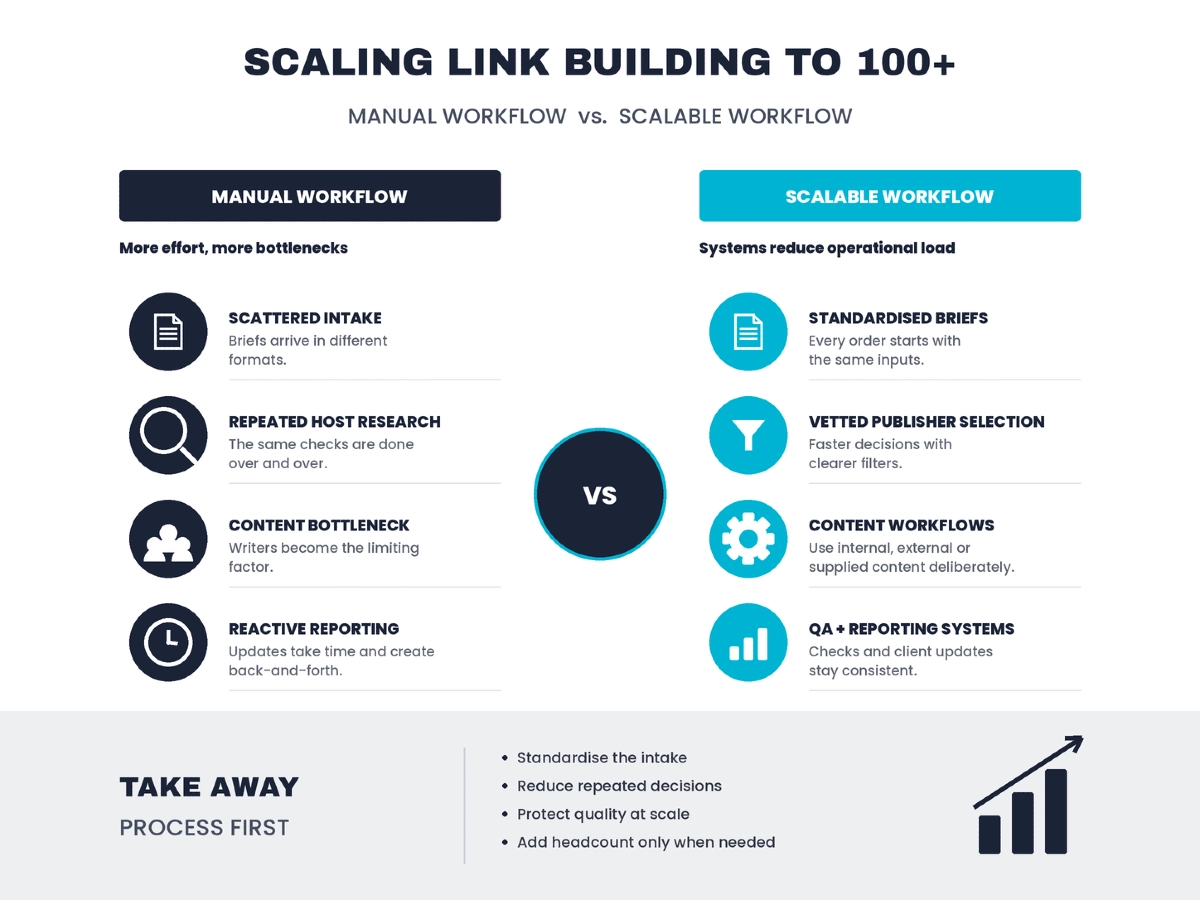
Scaling link building starts with understanding where the hours actually go.
What 100 links a month actually means
A hundred placements across approximately 21 working days means delivering close to five live links every day.
That is a production pipeline, not simply a monthly target.
Each placement moves through several stages: intake, publisher selection, content production, editorial review, publication, verification and client reporting.
At that volume, small inefficiencies become expensive.
An unnecessary fifteen minutes on every placement adds 25 hours to the monthly workload. A ten percent rejection rate means ten orders require additional attention. A missing field in every brief creates repeated conversations that should never have been necessary.
There is also a difference between placing 100 orders and delivering 100 live links.
If a publisher delays publication or rejects a submission, the agency still has a client commitment to manage.
The objective is therefore not to rush through more orders. It is to build a process that can deliver consistently without allowing quality to drift.
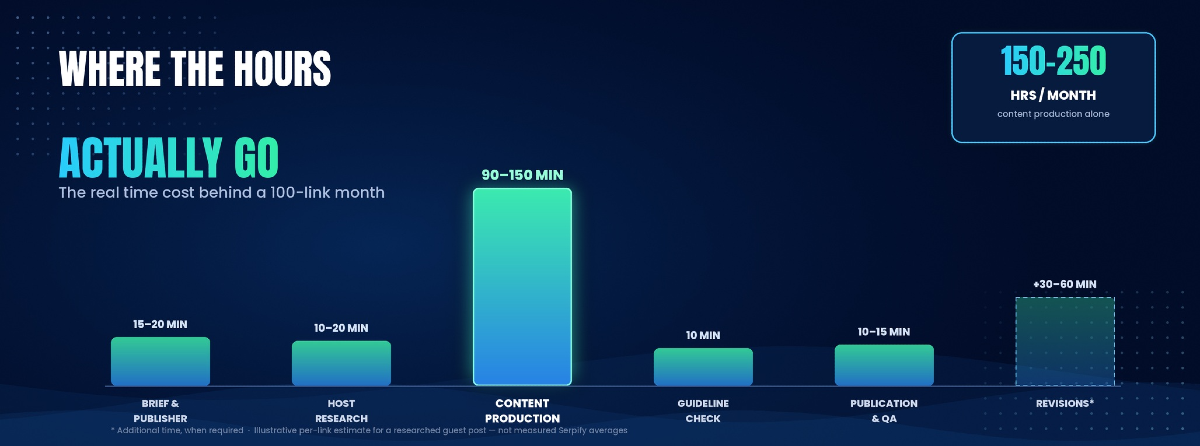
Where the hours actually go
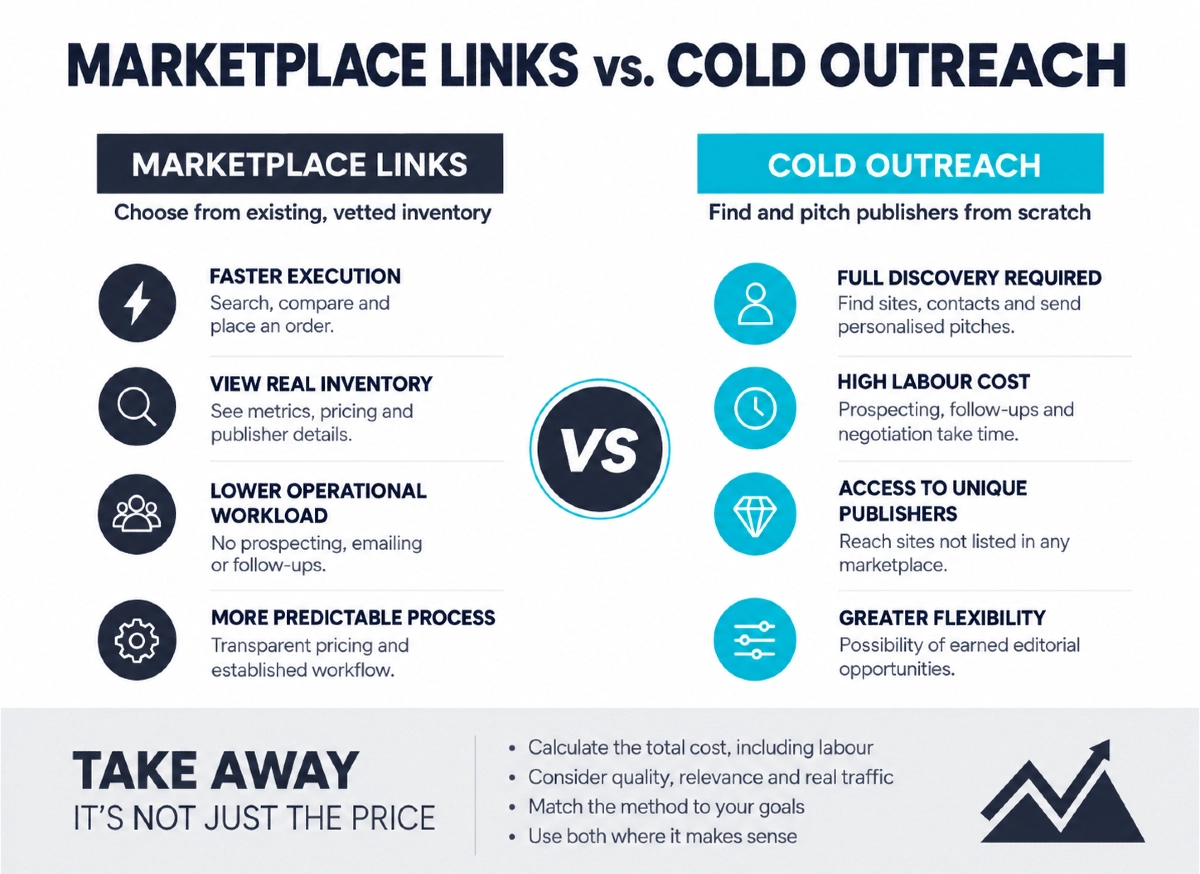
Our earlier comparison of marketplace links and cold outreach examines how much labour can be removed from the acquisition process when publishers are already available through an existing inventory.
But acquisition is only one part of the workload.
Content is often the next constraint.
Consider the following illustrative production model for a researched guest post.
| Pipeline stage | Estimated time per link |
| Brief intake and publisher selection | 15–20 min |
| Host site research | 10–20 min |
| Content production, 700–1,000 words | 90–150 min |
| Publisher guideline check | 10 min |
| Publication and live-link QA | 10–15 min |
| Revisions, when required | Additional 30–60 min |
These are working assumptions, not measured Serpify averages.
If all 100 placements require articles written internally, content production alone represents approximately 150–250 working hours per month.
That explains why hiring another writer can look like the obvious solution.
But there is another question worth asking.
Does every placement actually need to consume the same internal writing capacity?
For agencies using a combination of in-house content, external writers and content supplied with placements, the answer is often no.
The operational opportunity is to decide deliberately which work must remain internal and which can be handled elsewhere without compromising quality.
The SOPs that carry the load
A scalable link-building operation needs standard operating procedures that reduce repeated decisions.
The goal is not to turn editorial work into a mechanical process. It is to make sure writers and account managers spend their time on decisions that genuinely require judgment.
SOP 1: Standardise every brief
Every placement should enter the production pipeline through the same template.
At minimum, the brief needs the publisher, target URL, anchor text, topic, language, word count, requested publication date and any client-specific restrictions.
The publisher’s own editorial guidelines should be included before production begins.
This matters because requirements vary.
One site may restrict promotional language. Another may require additional editorial references, specific formatting or a particular number of words.
If those requirements are discovered after the article has been written, production time is wasted.
A complete brief moves that work to the beginning of the process, where it is much cheaper to resolve.
SOP 2: Research the host before writing
Publisher selection should not end when a site meets the client’s metric requirements.
The writer needs to understand what the publication actually covers.
Look at its audience, editorial categories, recent articles and general tone. Check whether the planned angle overlaps heavily with something already published.
An article can be accurate and well written while still being unsuitable for the publication receiving it.
The objective is to identify that problem before writing 1,000 words, not after submission.
This is also where the choice of placement format matters. Our guest posting vs. niche edits comparison explains when a dedicated article provides value and when an existing page may already offer the context a placement needs.
SOP 3: Separate writing from approval
At higher volumes, it becomes tempting to let the writer approve their own work.
That removes a step from the workflow, but it also removes an important safeguard.
A separate editorial pass should verify factual claims, source accuracy, anchor placement, client requirements and publisher guidelines.
For regulated industries such as gambling, finance and health, the review may also need to confirm jurisdiction-specific requirements and appropriate disclosures.
Not every article requires the same depth of review. However, the standard for approving a placement should remain consistent.
SOP 4: Create a rejection loop
Rejections are inevitable. Repeating the same preventable rejection is not.
Every rejected submission should be logged with the publisher, reason and action required.
Over time, that information can reveal recurring issues with particular publishers, content formats or client briefs.
A guideline that repeatedly causes revisions should be added to the intake template.
A publisher that changes its requirements should have those changes recorded before the next order.
The rejection log should make the operation more efficient each month.
SOP 5: Track anchors and publishers
At 100 placements across several clients, relying on memory is no longer realistic.
Each client should have a record of acquired links, target URLs, anchors, publishers and publication dates.
That makes it easier to identify repeated domains, concentrated anchor usage and gaps in topical coverage.
It also creates a reliable foundation for reporting.
For the wider framework around link quality, relevance and acquisition strategy, see our Link Building Fundamentals guide.
What to automate and what to keep human
Automation becomes valuable when it removes repetitive administration.
Order-status updates, reporting exports, publication reminders and routine live-link checks are natural candidates.
Research summaries, brief preparation and guideline checks can also be supported by automation, provided the results are reviewed before important decisions are made.
Publisher suitability is different.
A domain can meet the required traffic and authority thresholds while being editorially unsuitable for the client’s business.
The same applies to content approval.
AI can support research and drafting, but that does not remove the need for original work, factual accuracy and editorial relevance.
Google’s scaled content abuse policy targets content produced at scale primarily to manipulate search rankings rather than help users. The policy applies regardless of whether that content is generated through automation or human effort.
For agencies, the practical principle is straightforward: automate the administration, support the production process and retain human responsibility for the final editorial decisions.
The Serpify workflow for higher volumes
This is where a marketplace can change the operational model.
Instead of prospecting publishers and negotiating every placement individually, the agency starts with existing inventory.
Serpify allows buyers to filter publishers using criteria including traffic, domain rating, niche, language and geography.
That reduces the time spent building shortlists from scratch.
Content can also be requested alongside a placement. Serpify currently advertises content delivery in less than 24 business hours when requested, although the publisher’s own publication timeline remains a separate part of the process.
For an agency facing a content-production bottleneck, that flexibility can be significant.
The agency can retain internal writing capacity for strategic placements, specialist subjects and sensitive client work while using supplied content where appropriate.
Order status and live URLs can then be tracked through the platform rather than across separate publisher email conversations.
The value is not that every part of link building becomes automatic.
It is that the team can spend less time coordinating routine work and more time evaluating the quality of the final placements.
Reporting without creating another bottleneck
Reporting can quietly become one of the most time-consuming parts of a growing link-building operation.
A fixed reporting rhythm helps prevent that.
Weekly internal reporting should focus on delivery: orders submitted, placements published, outstanding items, revisions and missed deadlines.
Monthly client reporting should show live placements against the agreed target, publishers used, target URLs, anchor distribution and any placements requiring attention.
Quarterly strategic reporting can examine organic visibility, ranking changes, referral activity where measurable and whether the acquisition strategy needs adjusting.
The distinction matters because delivery and SEO impact are not the same thing.
A link going live is a completed operational task. Its contribution to organic performance needs to be considered over a longer period and alongside other changes affecting the website.
Agencies should avoid presenting every ranking movement as the direct result of a particular placement.
A capacity model for 100 placements
A useful way to plan capacity is to separate operational work from content production.
For example, a small agency might divide responsibility between an operations lead, a writer or editor and a reviewer.
The operations lead handles intake, publisher selection, deadlines and reporting.
The writer or editor manages content production and revisions.
The reviewer checks factual accuracy, editorial suitability and the final publication.
That division does not automatically establish that three people can deliver 100 placements every month.
The actual capacity depends on how much content is produced internally, the complexity of the clients, the publisher requirements and how much of the acquisition process is handled by the platform or external partners.
Using the illustrative writing estimate above, producing all 100 articles internally requires 150–250 hours of content production alone.
If the agency produces 40 articles internally and sources content for the remaining 60, the internal writing requirement falls to approximately 60–100 hours.
The rest of the workflow still needs to be managed, but the content bottleneck has changed substantially.
This is why scaling link building should begin with a capacity model rather than an automatic decision to hire.
Where scaling breaks
Even a well-documented workflow needs regular review.
Quality can decline when teams focus too heavily on delivery numbers. Rejections may increase when a publisher changes its rules. Repeated domains and unnatural anchor patterns can become more noticeable as acquisition volume grows.
Publishers can change too.
A site that previously had relevant content and genuine organic visibility may become overloaded with commercial placements or experience a substantial decline in traffic.
Regular publisher reviews help ensure that yesterday’s approved inventory does not become a permanent assumption about quality.
The same applies to the workflow itself.
If one type of rejection suddenly becomes more common, investigate the process that produced it rather than treating every affected article as an isolated problem.
Scale the process before the headcount
Reaching 100 links a month is not simply a question of finding more people to write articles and contact publishers.
It requires a workflow where every placement moves through a consistent process, every client requirement is documented and every completed link can be verified.
Some agencies will eventually need more staff. Others may find that their existing team has considerably more capacity once repetitive work is removed.
The difference comes from understanding which tasks create value and which tasks consume time without improving the final placement.
Standardise intake. Research the host. Separate writing from approval. Track publishers and anchors. Automate routine administration. Decide deliberately where content comes from.
Scale the process first. Then hire when the numbers justify it.
Serpify brings publisher discovery, placement selection, optional content and order tracking into one workflow, helping agencies manage acquisition without rebuilding the process for every order.
Explore Serpify’s link building marketplace
Scale Link Building: FAQ
How many links can one person manage per month?
There is no universal figure. Capacity depends on whether the person manages acquisition only or also handles content production, editorial review and client reporting. Separating these responsibilities makes the workload easier to measure.
Can AI help agencies scale link building content?
AI can support research, drafting and editorial administration. However, original value, factual accuracy and compliance with Google’s spam policies remain essential regardless of how content is produced.
What should a link building SOP include?
A standard brief template, publisher research, guideline checks, editorial review, rejection logging and records of acquired links, anchors and target URLs.
How often should agencies report link building results?
Weekly internal reporting helps manage delivery. Monthly client reporting can document completed placements, while quarterly reviews provide more room to evaluate organic performance and adjust the acquisition strategy.
Ask ten agency owners whether cold outreach or a link marketplace is more cost-effective and you will probably get ten different answers.
Most of them will start by comparing placement prices.
That is not the comparison that matters.
The more useful question is: what does it actually cost to get one suitable link live?
Cold outreach can create access to publishers that are unavailable through any marketplace. It can produce genuinely earned editorial opportunities and relationships that become more valuable over time.
A marketplace solves a different problem. It trades some of that open-ended discovery for visible inventory, predictable pricing and dramatically less operational work.
Once labour enters the calculation, the economics start to look very different.
The structural difference
Cold outreach begins with an empty prospect list.
Someone has to find relevant sites, qualify them, locate the right contacts, write the initial emails, follow up, handle replies, negotiate terms and then manage the placement through publication.
A marketplace begins further along the process.
The publisher relationships already exist. Available inventory can be searched and compared before an order is placed, and much of the contact, negotiation and follow-up work has already happened upstream.
That does not make marketplace placements automatically cheaper.
In fact, BuzzStream’s updated 2026 guest-post research found the opposite at the placement level. Its dataset put the average estimated direct price at $295, compared with $461 through a vendor. High-quality placements were considerably more expensive again.
That is precisely why placement price alone is the wrong metric.
The question is what happens when the cost of acquiring that placement is added to the invoice.
The acquisition channel is only one part of the wider link-building decision. Our Link Building Fundamentals guide covers the broader framework around relevance, link quality, anchor text and acquisition strategy. Once a publisher is available, the format matters too: our Guest Posting vs. Niche Edits comparison looks specifically at the trade-off between creating a new article and placing a link within an existing page.
Cold outreach: the hidden labour cost
Consider a campaign targeting 100 publishers.
For this model, we will use a fully loaded labour cost of £35 per hour. This is a modelling assumption, not an industry benchmark. An agency should replace it with its own internal cost.
We also need a reply rate.
Backlinko and Pitchbox analysed 12 million outreach emails and found an overall response rate of 8.5%. The research dates from 2019, so it should not be treated as a guaranteed 2026 performance benchmark. It does, however, provide a large established dataset that can be used as the basis for a model.
Finally, this model assumes that 18% of replies become live placements.
That 18% figure is an illustrative modelling assumption. It is not an industry benchmark.
| Activity | Time per unit | Volume | Labour |
|---|---|---|---|
| Prospecting and qualifying sites | 0.15 hr | 100 | 15.0 hrs |
| Personalised first emails | 0.10 hr | 100 | 10.0 hrs |
| Two templated follow-ups | 0.03 hr | 200 | 6.0 hrs |
| Reply handling and negotiation | 0.50 hr | 8.5 replies | 4.25 hrs |
| Placement management and QA | 0.50 hr | ~1.5 placements | 0.75 hrs |
| Total | 36.0 hrs |
An 8.5% reply rate produces approximately 8.5 replies.
At the assumed 18% reply-to-placement conversion rate, those 100 prospects generate around 1.53 live placements.
That works out at approximately 23.5 labour hours per live link.
At £35 per hour, the labour component alone is approximately £824 per placement.
And that is before content production, outreach software or any publisher fee is included.
SERPreach reports from its own dataset of more than 100,000 outreach emails that roughly 80% of webmasters who responded requested payment. This is proprietary provider data rather than a universal industry benchmark, but it illustrates why publisher fees do not necessarily disappear when links are acquired through outreach.
If we model £80–£150 in content costs, £15–£30 in outreach infrastructure and a £200–£400 publisher fee across 80% of placements, the expected publisher-fee component becomes £160–£320.
| Cost | Illustrative cost per live link |
|---|---|
| Labour | ~£824 |
| Content | £80–£150 |
| Expected publisher fee | £160–£320 |
| Outreach infrastructure | £15–£30 |
| Illustrative fully loaded cost | ~£1,079–£1,324 |
Those figures are not intended as a universal market price.
Change the hourly rate, reply rate, conversion rate or publisher fee and the result changes with them.
That is the point of calculating it.
Marketplace acquisition: what actually disappears
Now apply the same logic to a marketplace workflow.
There is still work involved. Someone needs to filter inventory, evaluate the publisher, prepare content or a brief and check the final publication.
But prospecting, contact discovery, cold emailing and repeated follow-ups are largely removed from the buyer’s workflow.
| Activity | Estimated labour |
|---|---|
| Filter inventory and select publisher | 0.30 hrs |
| Prepare brief or supply content | 0.20 hrs |
| Publication QA and link check | 0.20 hrs |
| Expected revision handling | 0.075 hrs |
| Total | ~0.78 hrs |
At the same £35 hourly rate, that represents approximately £27 in internal labour per placement.
Compared with the cold-outreach model, labour time has fallen by around 97%.
That does not mean the marketplace link itself is 97% cheaper.
It means the agency has removed almost all of the acquisition labour surrounding it.
That distinction matters.
BuzzStream’s 2026 pricing research illustrates why. Its average vendor price of $461 was higher than the estimated $295 direct price, but vendors typically handle work such as establishing the publisher connection and managing publication.
The placement fee can therefore be higher while the total operational cost remains competitive.
Side by side
The distinction becomes clearer when the two workflows are compared directly.
| Metric | Cold outreach | Marketplace |
|---|---|---|
| Labour per placement | ~23.5 hrs | ~0.78 hrs |
| Labour cost at £35/hr | ~£824 | ~£27 |
| Prospecting required | Yes | No or limited |
| Publisher negotiation | Yes | Usually handled upstream |
| Inventory selection | Research required | Search/filter existing inventory |
| Follow-up required | Yes | Usually limited |
| Publication QA | Buyer-managed | Buyer/platform-managed depending on service |
| Unlisted publisher discovery | Strong | Limited to available inventory |
| Cost predictability | Lower | Higher |
| Turnaround | Campaign-dependent | Inventory and publisher-dependent |
The biggest marketplace saving in this model is therefore not necessarily the price of the placement.
It is everything that happens before the placement exists.
The price of the link is not the cost of the link
Imagine two comparable publishers.
One quotes £300 after your team finds the site, identifies an editor, sends several emails and negotiates the placement.
The other appears in a marketplace for £400.
Looking only at the publisher fee makes the first opportunity £100 cheaper.
But if acquiring that £300 placement required several hours of employee time, the cheaper invoice may have produced the more expensive link.
The reverse can also happen.
A marketplace may contain a publisher priced well above what an experienced outreach team could negotiate directly. Agencies with established relationships, efficient processes and strong conversion rates may therefore achieve much better outreach economics than the model above.
There is no universal winner.
The useful metric is fully loaded cost per suitable live link.
Where cold outreach still earns its keep
Labour efficiency is not the only thing that matters.
Cold outreach has one major structural advantage over any fixed marketplace: the potential universe of publishers is much larger.
If you specifically want coverage from a particular industry publication, regional newspaper, specialist resource or company blog, you can approach it whether or not that site has ever listed a placement for sale.
That matters even more when the objective is an earned link rather than a purchased placement.
Original research, newsworthy data, expert commentary and digital PR can produce editorial coverage without paying the publisher for the link at all.
Those opportunities are fundamentally different from buying access to available inventory.
Relationships can compound too.
A publisher that has already worked successfully with your agency may respond more quickly next time, accept stronger ideas and require much less negotiation. The economics of the fourth collaboration can therefore look nothing like the economics of the first cold email.
This is why treating outreach purely as an inefficient version of a marketplace misses its strongest use case.
Outreach becomes particularly valuable when the publisher itself is the target.
What marketplaces actually optimise
Marketplaces work best when the requirement starts with criteria rather than one specific publication.
You may need a relevant UK site in a particular niche, with genuine organic visibility, acceptable domain metrics and a placement within a defined budget.
Without existing publisher relationships, building that shortlist manually can take hours before a single email is sent.
Existing inventory changes the workflow.
Serpify allows buyers to filter available publishers using criteria including traffic, domain rating, niche, language and geography. Order status and live placements can also be tracked through the platform, while publishers are manually vetted and continuously reviewed.
The advantage is not unlimited access.
It is visibility into the access that already exists.
That makes costs easier to forecast and reduces the amount of labour committed before you know whether an appropriate placement is available.
The risk picture in 2026
Acquisition method should not be confused with link quality.
A marketplace can contain weak opportunities.
An outreach list can contain exactly the same weak opportunities.
BuzzStream’s expanded 2026 study shows how uneven the commercial guest-post market can be. Using its own quality framework, only 1.37% of the sites it analysed qualified as High Quality or Top Tier, while 96.2% fell into its Low Quality category.
Those are BuzzStream’s thresholds, not Google’s, and DR plus estimated traffic alone cannot determine whether a placement is worthwhile.
But the wider point holds.
Large inventory is useful only if you filter it properly.
Traffic quality, topical relevance, editorial standards, publishing history, outbound linking patterns and the actual page containing the link matter regardless of how the publisher was discovered.
There is also an important policy distinction.
A genuinely earned editorial link obtained through outreach is not the same thing as a paid placement.
When money or another form of compensation is exchanged for a link, Google’s guidance is that paid links should be qualified with rel="sponsored" or rel="nofollow", with sponsored preferred for advertising and paid placements.
Reaching a publisher through a personal email does not change the nature of the transaction if payment is ultimately involved.
The acquisition channel and the policy status of the link are two separate questions.
Marketplace Links vs Cold Outreach: The strongest model uses both
For most agencies, this does not need to become an ideological choice between outreach and marketplaces.
They are useful for different jobs.
A marketplace makes sense when suitable inventory already exists and the goal is to acquire relevant placements with low operational friction.
Outreach makes sense when the desired publisher is not available through that inventory, when a relationship has strategic value, or when the campaign is designed to earn editorial coverage rather than purchase a placement.
The mistake is treating every link as though it should go through the same acquisition process.
If a £300 placement requires £800 of labour to acquire, the invoice is not telling you what the link cost.
If a £500 marketplace placement takes less than an hour to source and manage, its higher sticker price does not automatically make it the more expensive option either.
The numbers have to be considered together.
Judge the acquisition cost, not the sticker price
Cold outreach gives you reach beyond existing inventory.
Marketplaces give you access to opportunities without recreating the entire discovery and outreach process for every placement.
One prioritises flexibility.
The other prioritises operational efficiency.
The right question is therefore not whether marketplaces are cheaper than outreach.
It is whether the additional labour required by outreach produces something worth paying for.
When it gives you access to a publisher you could not otherwise reach, an earned editorial opportunity or a valuable long-term relationship, the answer may easily be yes.
When the same type of suitable placement is already available through existing inventory, spending another 20 hours trying to recreate that access becomes much harder to justify.
Calculate the full acquisition cost first. Then choose the channel.
Ask ten SEOs which link type works better and you will probably get ten different answers, many of them shaped by whichever service they happen to sell.
The more useful question is narrower: faster at what, at what cost, and with what level of risk?
Guest posts and niche edits are not simply two versions of the same link-building tactic. They solve different problems, operate on different timelines, and give you very different levels of control.
Here is how they compare when you use both as part of a broader link-building strategy.
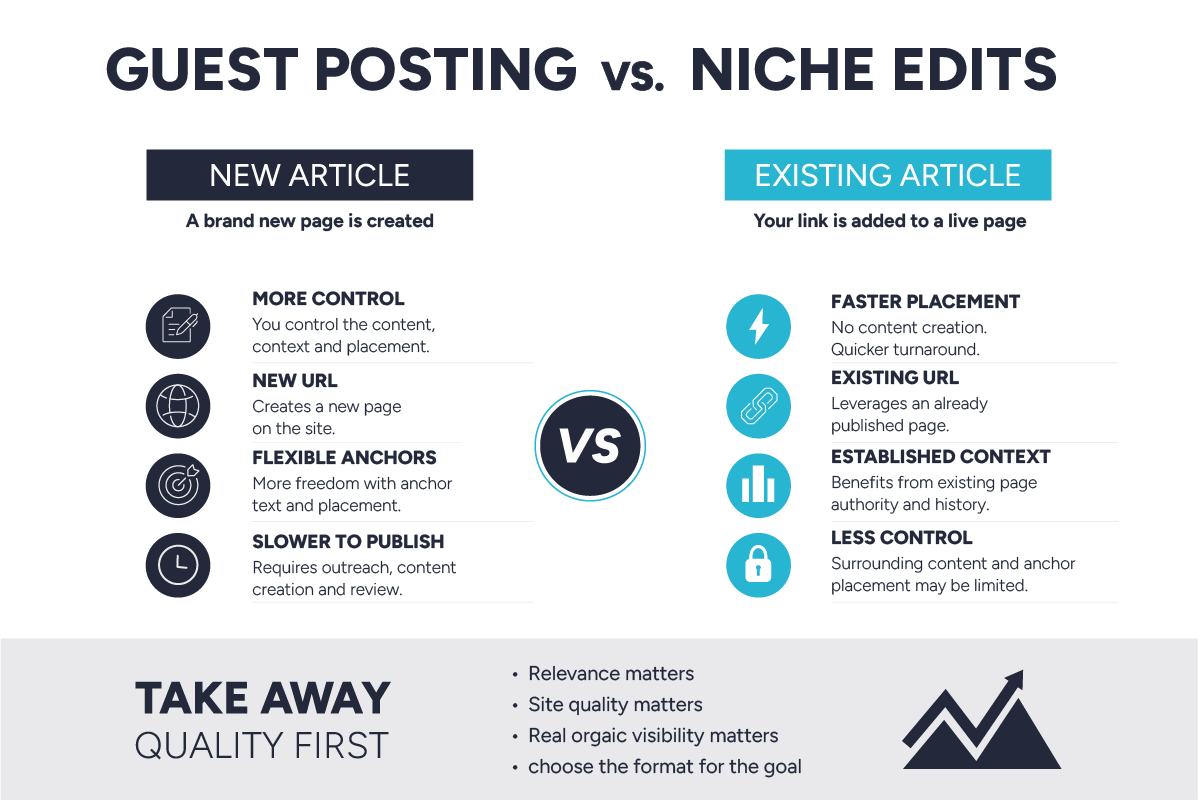
The structural difference
A guest post is a new article written for a host publication and published on a new URL, with your link placed naturally inside the content.
A niche edit, sometimes called a link insertion, adds a link to a page that already exists.
That distinction affects almost everything that follows.
A guest post creates a new piece of content around the link. A niche edit places the link inside an existing asset whose topic, history, internal links, and surrounding copy are already established.
Side by side
| Guest post | Niche edit | |
| Typical cost | Often higher because content production may be included alongside the placement | Often lower because no new article needs to be produced |
| Time to live | Usually days to weeks, depending on the publisher’s editorial process | Often hours to days |
| Potential discovery speed | Depends heavily on how quickly the new page is crawled, indexed, and internally linked | Can be faster because the host URL may already be crawled and indexed |
| Content control | High. You can usually shape the article and surrounding context | Limited. The existing article determines most of the context |
| Anchor flexibility | High, provided the anchor remains editorially natural | Moderate. The anchor needs to fit the existing copy |
| Editorial friction | Often higher due to review, revisions, and publisher guidelines | Usually lower once a suitable page has been identified |
| Scalability | Limited partly by content production and publisher turnaround | Limited by the supply of genuinely relevant existing pages |
| Durability | Potentially strong, but the publisher still controls the URL and link | Potentially less predictable because edits can be changed or removed later |
Guest Posting vs. Niche Edits: Two Different Clocks
The word “faster” hides an important distinction.
There is placement speed, meaning how quickly the link goes live.
Then there is signal speed, meaning how quickly search engines discover and process the updated or newly published page.
Niche edits often have an advantage on the first measure. There is no new article to commission, not a full editorial review to complete, and usually no publication schedule to wait for. Once a suitable page is identified and approved, the change can be relatively quick.
They can also have an advantage on the second.
An existing page may already be indexed, internally linked, receiving organic traffic, and earning backlinks of its own. Once that page is recrawled, the new link can be discovered within an already established document.
A new guest post does not necessarily receive the same page-level support immediately.
That does not mean it “starts from zero.” A good publisher may feature it on category pages, link to it from related articles, include it in a sitemap, or surface it prominently across the site. But a guest post published deep in an archive with little internal support may take longer to accumulate meaningful page-level signals.
That is the strongest practical case for niche edits when speed matters.
It is not, however, the whole comparison.
Where guest posts pull ahead
Control is the advantage niche-edit comparisons often underestimate.
With a guest post, you can shape the paragraph around the link rather than trying to make a new sentence fit into somebody else’s article.
You can control the topic, supporting arguments, semantic context, related terminology, and external references surrounding the placement.
That matters because Google uses links and their surrounding context as signals for understanding relationships and relevance between pages.
A niche edit gives you much less room to work.
If the article is outdated, loosely related to your target page, poorly written, or already overloaded with commercial links, your placement inherits those weaknesses.
A guest post can also create a more substantial editorial asset.
The publisher may continue to update it, link to it internally, feature it in relevant sections, or allow it to attract backlinks over time.
That does not mean you own the page. You do not. The publisher can still edit or remove the article or link later.
But a dedicated piece of content generally gives you more control over the initial environment in which the link appears.
The risk picture in 2026
Both guest posts and niche edits need to be considered against Google’s spam policies.
Google treats buying or selling links for ranking purposes as link spam. Paid placements should be qualified with rel=”sponsored” or rel=”nofollow”, with sponsored being Google’s preferred attribute for advertising and paid links.
That applies regardless of whether the link appears in a newly published guest article or is inserted into an existing page.
The format itself is not the deciding factor.
The larger risk comes from how the link is acquired, why the content exists, and the quality of the site publishing it.
There are several areas worth paying particular attention to.
Link spam remains the most obvious. Google’s examples include paid links intended to manipulate rankings, excessive link exchanges, automated link creation, and advertorial or guest-post links containing optimised anchor text when those placements are created primarily for ranking purposes.
Site reputation abuse is also highly relevant. Google uses the term for situations where third-party content is published primarily to take advantage of a host site’s established ranking signals rather than because the material genuinely belongs on the publication.
A broad website is not automatically a bad website, and publishing across several topics is not itself a violation. The more useful question is whether the content fits the publisher’s audience and editorial purpose, or whether entire sections appear to exist mainly to monetise the domain’s existing search reputation.
Expired domain abuse is another warning sign. Historical domain authority does not make a site valuable if the domain has been repurposed primarily to manipulate search rankings through unrelated or low-value content.
These distinctions matter because simplistic shortcuts such as “only buy links from single-niche sites” do not accurately describe Google’s policies.
A genuine national newspaper can cover politics, sport, business, technology, culture, and travel without being a content farm.
A supposedly “topical” site can still be little more than a collection of paid placements.
The editorial standard matters more than the number of categories in the navigation menu.
What SpamBrain changes
Google has explicitly said that SpamBrain can identify and neutralise unnatural links.
That distinction matters.
Not every bad link needs to result in a manual action or an obvious ranking collapse. A link can simply stop providing the ranking credit the buyer expected it to provide.
Automated neutralisation may happen without a manual-action notice.
At the same time, manual actions and broader ranking demotions remain possible under Google’s spam policies.
For link builders, that makes source quality particularly important. A placement can remain live, remain indexed, and remain visible in a backlink tool while contributing far less than expected.
That is a much harder failure to diagnose than a link that disappears completely.
What nobody mentions about guest-post timelines
If most of your link acquisition has happened through marketplaces or dashboards, the editorial reality of guest posting can come as a surprise.
Real publishers have real guidelines.
They may have minimum and maximum word counts, restrictions on commercial anchors, rules governing do-follow and no-follow links, title requirements, image specifications, disclosure rules, category limitations, or requirements for citing external sources.
Some publishers prohibit overtly promotional language. Others require sponsored-content labelling. Some will reject an otherwise strong article simply because it does not fit an existing editorial section.
Articles get rejected.
They get sent back for revisions.
Facts need to be rechecked. Headings are changed. Anchors are rewritten. Entire sections sometimes need to be removed because they sound too commercial.
None of that is necessarily a disadvantage.
Editorial friction can be a sign that a publisher is protecting the quality of the site rather than accepting anything sent to them.
But it needs to be reflected in your timeline and your budget.
A guest post is a production process, not simply a transaction.
Niche edits can bypass much of that production cycle, which remains one of their strongest operational advantages.
👉 One important note on terminology: what the industry commonly calls niche edits is also known as link insertions – and that’s the term we use in the Serpify marketplace. So when you see “Link Insertion” on Serpify, we’re talking about a link being added to an existing, relevant piece of content. Same concept, different name.
How to actually choose
The better question is not whether guest posts or niche edits are universally superior.
It is which format solves the problem you have right now.
Reach for niche edits when speed matters, when you find an existing page with unusually strong topical alignment, when the target page already has some authority, or when producing a completely new article adds little value.
Reach for guest posts when you need greater control over topical framing, when the target page requires more context, when brand presentation matters, or when you want to build a dedicated piece of editorial content around the subject.
Use both when the campaign benefits from different types of editorial placements and you can maintain the same quality threshold across them.
The goal should not be to manufacture a backlink profile that merely looks natural.
The goal should be to earn or place links in contexts that make sense editorially, using a mix that gives you the right balance of relevance, control, coverage, speed, and cost.

Judge the site before the link type
If there is one takeaway, it is that the guest-post-versus-niche-edit question is secondary.
A highly relevant niche edit on a credible, well-maintained publication can be a much stronger prospect than a guest post on a weak site built primarily around selling placements.
The reverse is equally possible.
Link format influences speed, cost, workflow, and control.
The quality and relevance of the source determine whether the opportunity is worth pursuing in the first place.
That means filtering matters more than format.
Look beyond headline domain metrics.
Check whether the site has real organic visibility. Look at the subjects it genuinely ranks for. Examine recent publishing activity, editorial consistency, country relevance, content quality, outbound linking patterns, and whether the page you are considering actually makes sense for your target.
Metrics help narrow the field.
Editorial judgment decides what survives the shortlist.
Serpify’s marketplace lets you screen opportunities using dimensions such as niche, domain metrics, country, traffic, and price, making it easier to compare potential placements before committing budget.
Set your relevance and quality thresholds first.
Then decide whether a guest post or niche edit best fits the target page and the timeline.