
Scaling to 100+ Links per Month Without Hiring More Staff

Most agencies eventually reach a point where link building becomes more difficult to manage than to sell.
At 20 placements a month, a small team can usually keep track of publishers, deadlines, content and client requirements without much trouble.
At 50, the cracks start to show.
At 100, every undocumented decision, missing brief and rejected article becomes another operational problem.
The instinct is often to hire. Another outreach specialist, another writer or another account manager to keep clients informed.
But before increasing headcount, agencies need to establish whether the constraint is genuine capacity or the way existing capacity is being used.
Scaling link building starts with understanding where the hours actually go.
What 100 links a month actually means
A hundred placements across approximately 21 working days means delivering close to five live links every day.
That is a production pipeline, not simply a monthly target.
Each placement moves through several stages: intake, publisher selection, content production, editorial review, publication, verification and client reporting.
At that volume, small inefficiencies become expensive.
An unnecessary fifteen minutes on every placement adds 25 hours to the monthly workload. A ten percent rejection rate means ten orders require additional attention. A missing field in every brief creates repeated conversations that should never have been necessary.
There is also a difference between placing 100 orders and delivering 100 live links.
If a publisher delays publication or rejects a submission, the agency still has a client commitment to manage.
The objective is therefore not to rush through more orders. It is to build a process that can deliver consistently without allowing quality to drift.
Where the hours actually go
Our earlier comparison of marketplace links and cold outreach examines how much labour can be removed from the acquisition process when publishers are already available through an existing inventory.
But acquisition is only one part of the workload.
Content is often the next constraint.
Consider the following illustrative production model for a researched guest post.
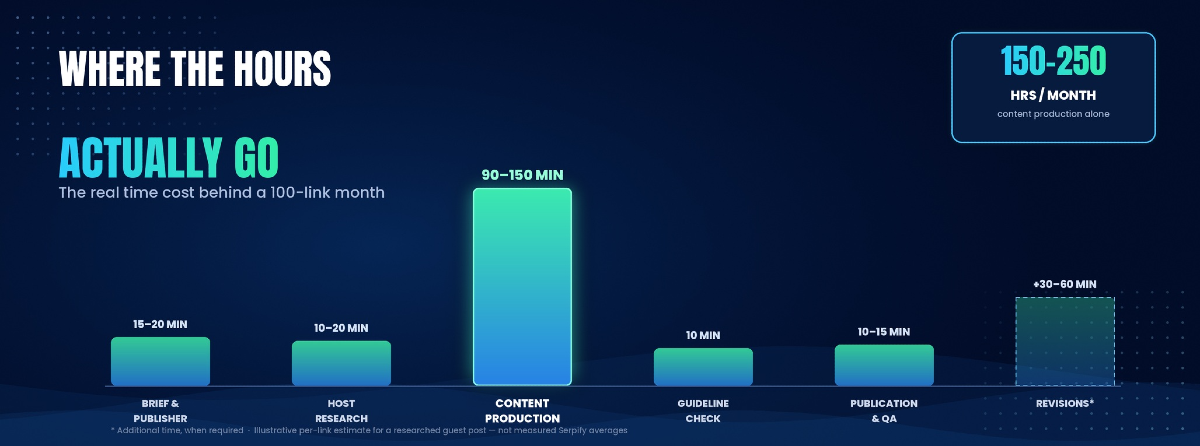
| Pipeline stage | Estimated time per link |
| Brief intake and publisher selection | 15–20 min |
| Host site research | 10–20 min |
| Content production, 700–1,000 words | 90–150 min |
| Publisher guideline check | 10 min |
| Publication and live-link QA | 10–15 min |
| Revisions, when required | Additional 30–60 min |
These are working assumptions, not measured Serpify averages.
If all 100 placements require articles written internally, content production alone represents approximately 150–250 working hours per month.
That explains why hiring another writer can look like the obvious solution.
But there is another question worth asking.
Does every placement actually need to consume the same internal writing capacity?
For agencies using a combination of in-house content, external writers and content supplied with placements, the answer is often no.
The operational opportunity is to decide deliberately which work must remain internal and which can be handled elsewhere without compromising quality.
The SOPs that carry the load
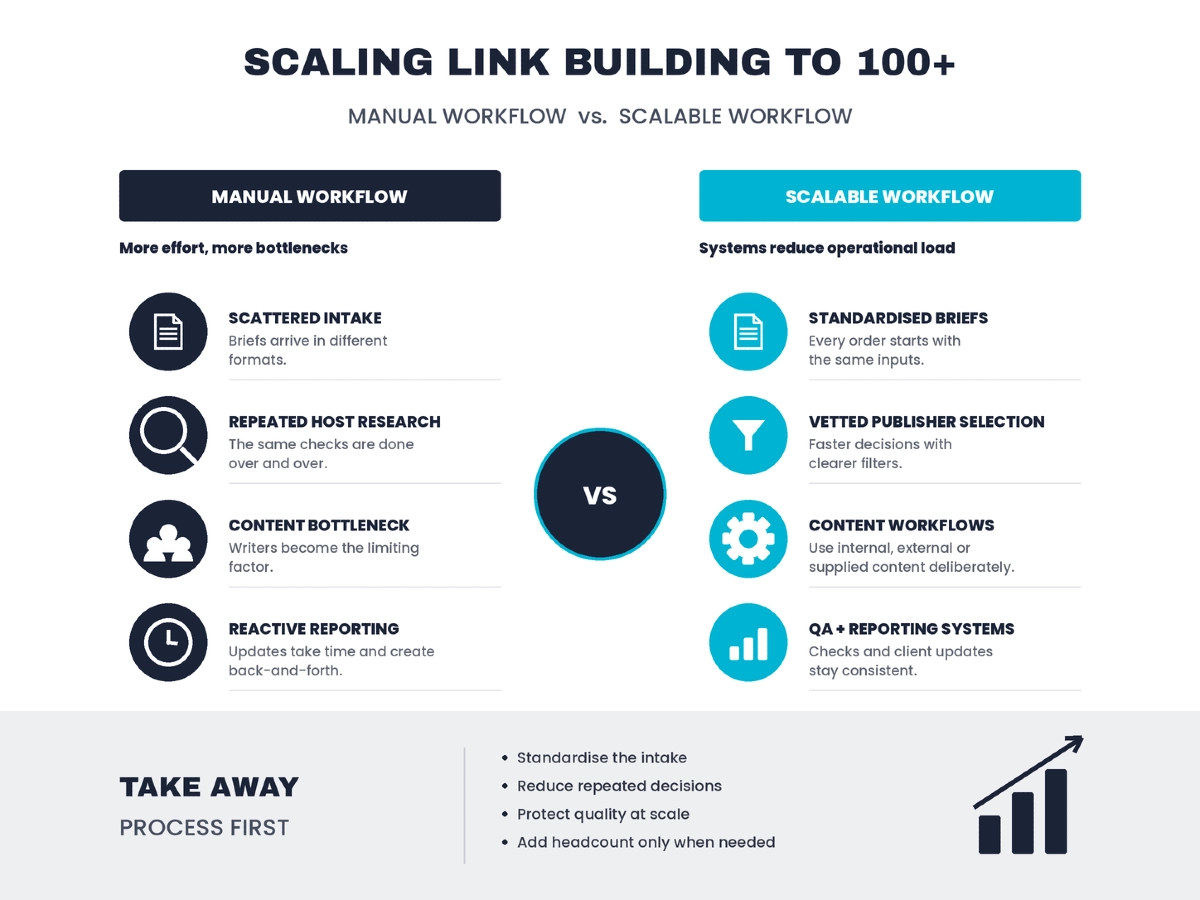
A scalable link-building operation needs standard operating procedures that reduce repeated decisions.
The goal is not to turn editorial work into a mechanical process. It is to make sure writers and account managers spend their time on decisions that genuinely require judgment.
SOP 1: Standardise every brief
Every placement should enter the production pipeline through the same template.
At minimum, the brief needs the publisher, target URL, anchor text, topic, language, word count, requested publication date and any client-specific restrictions.
The publisher’s own editorial guidelines should be included before production begins.
This matters because requirements vary.
One site may restrict promotional language. Another may require additional editorial references, specific formatting or a particular number of words.
If those requirements are discovered after the article has been written, production time is wasted.
A complete brief moves that work to the beginning of the process, where it is much cheaper to resolve.
SOP 2: Research the host before writing
Publisher selection should not end when a site meets the client’s metric requirements.
The writer needs to understand what the publication actually covers.
Look at its audience, editorial categories, recent articles and general tone. Check whether the planned angle overlaps heavily with something already published.
An article can be accurate and well written while still being unsuitable for the publication receiving it.
The objective is to identify that problem before writing 1,000 words, not after submission.
This is also where the choice of placement format matters. Our guest posting vs. niche edits comparison explains when a dedicated article provides value and when an existing page may already offer the context a placement needs.
SOP 3: Separate writing from approval
At higher volumes, it becomes tempting to let the writer approve their own work.
That removes a step from the workflow, but it also removes an important safeguard.
A separate editorial pass should verify factual claims, source accuracy, anchor placement, client requirements and publisher guidelines.
For regulated industries such as gambling, finance and health, the review may also need to confirm jurisdiction-specific requirements and appropriate disclosures.
Not every article requires the same depth of review. However, the standard for approving a placement should remain consistent.
SOP 4: Create a rejection loop
Rejections are inevitable. Repeating the same preventable rejection is not.
Every rejected submission should be logged with the publisher, reason and action required.
Over time, that information can reveal recurring issues with particular publishers, content formats or client briefs.
A guideline that repeatedly causes revisions should be added to the intake template.
A publisher that changes its requirements should have those changes recorded before the next order.
The rejection log should make the operation more efficient each month.
SOP 5: Track anchors and publishers
At 100 placements across several clients, relying on memory is no longer realistic.
Each client should have a record of acquired links, target URLs, anchors, publishers and publication dates.
That makes it easier to identify repeated domains, concentrated anchor usage and gaps in topical coverage.
It also creates a reliable foundation for reporting.
For the wider framework around link quality, relevance and acquisition strategy, see our Link Building Fundamentals guide.
What to automate and what to keep human
Automation becomes valuable when it removes repetitive administration.
Order-status updates, reporting exports, publication reminders and routine live-link checks are natural candidates.
Research summaries, brief preparation and guideline checks can also be supported by automation, provided the results are reviewed before important decisions are made.
Publisher suitability is different.
A domain can meet the required traffic and authority thresholds while being editorially unsuitable for the client’s business.
The same applies to content approval.
AI can support research and drafting, but that does not remove the need for original work, factual accuracy and editorial relevance.
Google’s scaled content abuse policy targets content produced at scale primarily to manipulate search rankings rather than help users. The policy applies regardless of whether that content is generated through automation or human effort.
For agencies, the practical principle is straightforward: automate the administration, support the production process and retain human responsibility for the final editorial decisions.
The Serpify workflow for higher volumes
This is where a marketplace can change the operational model.
Instead of prospecting publishers and negotiating every placement individually, the agency starts with existing inventory.
Serpify allows buyers to filter publishers using criteria including traffic, domain rating, niche, language and geography.
That reduces the time spent building shortlists from scratch.
Content can also be requested alongside a placement. Serpify currently advertises content delivery in less than 24 business hours when requested, although the publisher’s own publication timeline remains a separate part of the process.
For an agency facing a content-production bottleneck, that flexibility can be significant.
The agency can retain internal writing capacity for strategic placements, specialist subjects and sensitive client work while using supplied content where appropriate.
Order status and live URLs can then be tracked through the platform rather than across separate publisher email conversations.
The value is not that every part of link building becomes automatic.
It is that the team can spend less time coordinating routine work and more time evaluating the quality of the final placements.
Reporting without creating another bottleneck
Reporting can quietly become one of the most time-consuming parts of a growing link-building operation.
A fixed reporting rhythm helps prevent that.
Weekly internal reporting should focus on delivery: orders submitted, placements published, outstanding items, revisions and missed deadlines.
Monthly client reporting should show live placements against the agreed target, publishers used, target URLs, anchor distribution and any placements requiring attention.
Quarterly strategic reporting can examine organic visibility, ranking changes, referral activity where measurable and whether the acquisition strategy needs adjusting.
The distinction matters because delivery and SEO impact are not the same thing.
A link going live is a completed operational task. Its contribution to organic performance needs to be considered over a longer period and alongside other changes affecting the website.
Agencies should avoid presenting every ranking movement as the direct result of a particular placement.
A capacity model for 100 placements
A useful way to plan capacity is to separate operational work from content production.
For example, a small agency might divide responsibility between an operations lead, a writer or editor and a reviewer.
The operations lead handles intake, publisher selection, deadlines and reporting.
The writer or editor manages content production and revisions.
The reviewer checks factual accuracy, editorial suitability and the final publication.
That division does not automatically establish that three people can deliver 100 placements every month.
The actual capacity depends on how much content is produced internally, the complexity of the clients, the publisher requirements and how much of the acquisition process is handled by the platform or external partners.
Using the illustrative writing estimate above, producing all 100 articles internally requires 150–250 hours of content production alone.
If the agency produces 40 articles internally and sources content for the remaining 60, the internal writing requirement falls to approximately 60–100 hours.
The rest of the workflow still needs to be managed, but the content bottleneck has changed substantially.
This is why scaling link building should begin with a capacity model rather than an automatic decision to hire.
Where scaling breaks
Even a well-documented workflow needs regular review.
Quality can decline when teams focus too heavily on delivery numbers. Rejections may increase when a publisher changes its rules. Repeated domains and unnatural anchor patterns can become more noticeable as acquisition volume grows.
Publishers can change too.
A site that previously had relevant content and genuine organic visibility may become overloaded with commercial placements or experience a substantial decline in traffic.
Regular publisher reviews help ensure that yesterday’s approved inventory does not become a permanent assumption about quality.
The same applies to the workflow itself.
If one type of rejection suddenly becomes more common, investigate the process that produced it rather than treating every affected article as an isolated problem.
Scale the process before the headcount
Reaching 100 links a month is not simply a question of finding more people to write articles and contact publishers.
It requires a workflow where every placement moves through a consistent process, every client requirement is documented and every completed link can be verified.
Some agencies will eventually need more staff. Others may find that their existing team has considerably more capacity once repetitive work is removed.
The difference comes from understanding which tasks create value and which tasks consume time without improving the final placement.
Standardise intake. Research the host. Separate writing from approval. Track publishers and anchors. Automate routine administration. Decide deliberately where content comes from.
Scale the process first. Then hire when the numbers justify it.
Serpify brings publisher discovery, placement selection, optional content and order tracking into one workflow, helping agencies manage acquisition without rebuilding the process for every order.
Explore Serpify’s link building marketplace
Scale Link Building: FAQ
How many links can one person manage per month?
There is no universal figure. Capacity depends on whether the person manages acquisition only or also handles content production, editorial review and client reporting. Separating these responsibilities makes the workload easier to measure.
Can AI help agencies scale link building content?
AI can support research, drafting and editorial administration. However, original value, factual accuracy and compliance with Google’s spam policies remain essential regardless of how content is produced.
What should a link building SOP include?
A standard brief template, publisher research, guideline checks, editorial review, rejection logging and records of acquired links, anchors and target URLs.
How often should agencies report link building results?
Weekly internal reporting helps manage delivery. Monthly client reporting can document completed placements, while quarterly reviews provide more room to evaluate organic performance and adjust the acquisition strategy.